
Programmable light processors, built for the quantum era.
Q-Memory designs programmable, room-temperature photonic processors: chips that steer and mix light under software control. We build them for quantum research labs today and quantum data centers tomorrow, with AI acceleration on the same platform.
Try the simulatorFollow our progress
What we are building
A photonic processor is a network of tiny light paths on a chip. Where paths meet, a tunable interferometer decides how much light goes each way. Set all of them from software and the chip performs a chosen operation on the light passing through. Change the settings and it performs a different one, on the same chip.
Room temperature
The processor chip runs at room temperature. Single-photon detectors, where an experiment uses them, sit in a compact cooler.
Programmable
One chip, many experiments, reconfigured in software.
Made with chip-industry methods
Wafer-scale lithography on a low-loss material that is well established for photonics.
VION in your browser
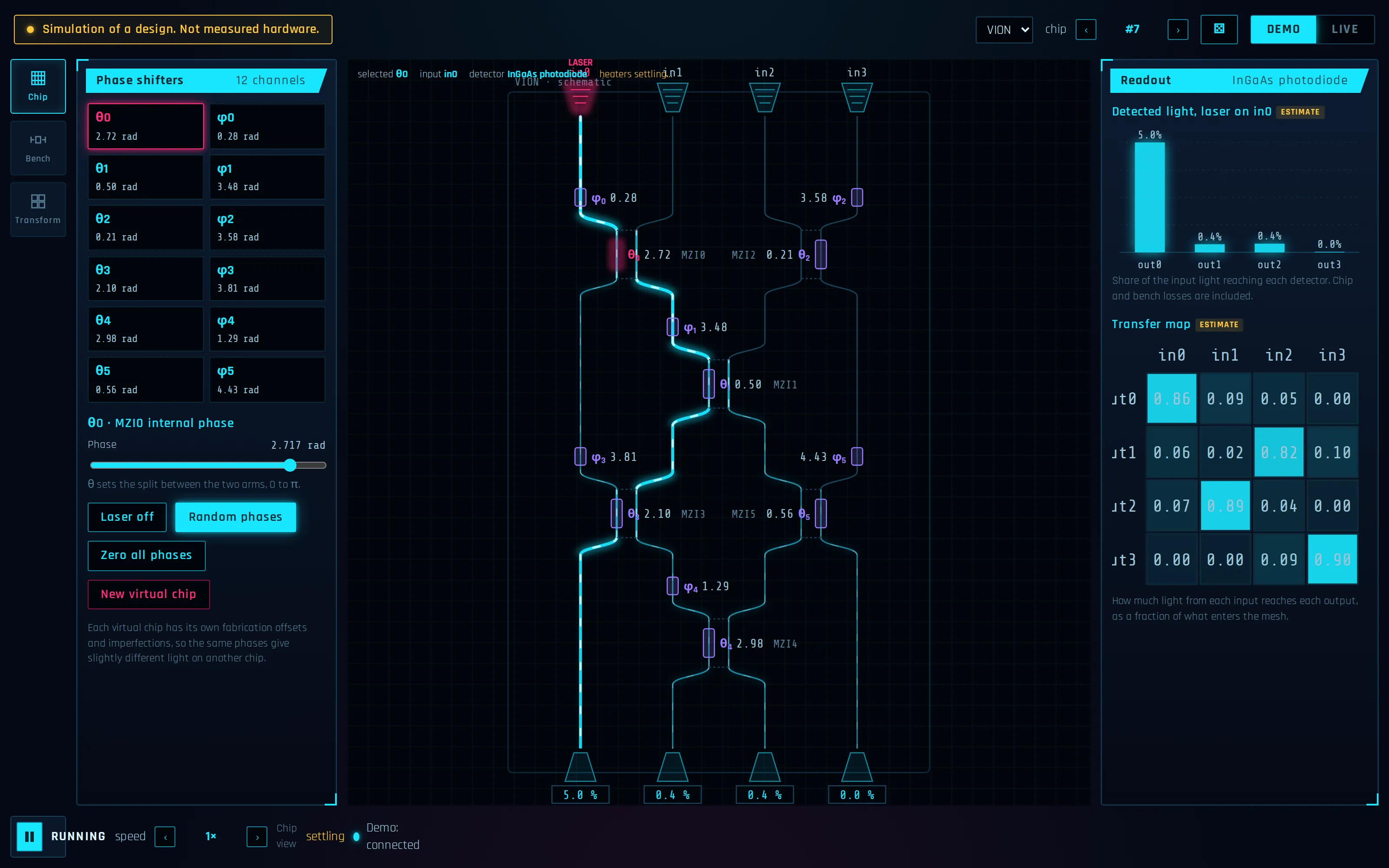
VION is our first product: a four-channel programmable light processor. Our online simulator runs the VION design, so you can program it before the first chips exist.
- Set each phase shifter and watch the light re-route through the mesh.
- Pick a target operation and let the simulator program the chip to match it.
- Swap lasers, photon sources and detectors on a virtual lab bench.
- Try a new virtual chip: each one carries its own fabrication imperfections.
A memory layer for light
Today’s programmable photonic chips hold each setting by continuously heating a small part of the chip. That costs power, produces heat, and makes the chip drift.
Our memory layer (patent filed) is designed to hold settings at near-zero power, for processors that are more stable and lower-power, which matters when many chips share a rack.
Where the work stands
VION is planned for fabrication in collaboration with Sabancı University Nanotechnology Research and Application Center (SUNUM). First chips are planned for December 2026.
4
light channels in VION, our programmable light processor
Design
3
performance benchmarks VION is validated against
Design
June 2026
UK patent application filed.
On record
Every figure on this site says how we know it.
- Design
- A property of our chip design.
- On record
- A matter of public record.
A roadmap built on measured results
Each phase builds on measured results from the one before, so every step rests on proven performance.
VION: our first programmable processor
A four-channel programmable light processor that proves the platform works as well as the simulations say.
AXIOM: one chip for quantum and AI
A larger programmable processor that runs quantum circuits, quantum machine learning and AI acceleration on the same chip.
Next phase and beyond: toward quantum data centers
Processors for quantum data centers, and classical optical processing on the same platform.
Follow the build
We send an update when a milestone is reached.